Prolotherapy in Syracuse, NY: What Patients Should Understand Before Choosing a Non-Surgical Option
Prolotherapy in Syracuse, NY: The Short Answer
If you are searching for prolotherapy in Syracuse, NY, you are likely trying to understand a non-surgical option for ongoing musculoskeletal pain before deciding whether to pursue it. Prolotherapy is a non-surgical regenerative injection technique. It delivers small amounts of an irritant solution, most commonly dextrose, to degenerated tendon insertions, joints, ligaments, and adjacent joint spaces over a series of treatment sessions. It is discussed as an option when pain or functional limits persist despite medication or exercise. The leading theory is that the injected solution triggers a local healing-type inflammatory response, but the mechanism is not completely understood. Importantly, this article cannot tell you whether prolotherapy is appropriate for you. That is a decision for you and a qualified clinician, based on your history, examination, and goals.[PubMed Central]
What Is Prolotherapy, and Why Do People Ask About It?
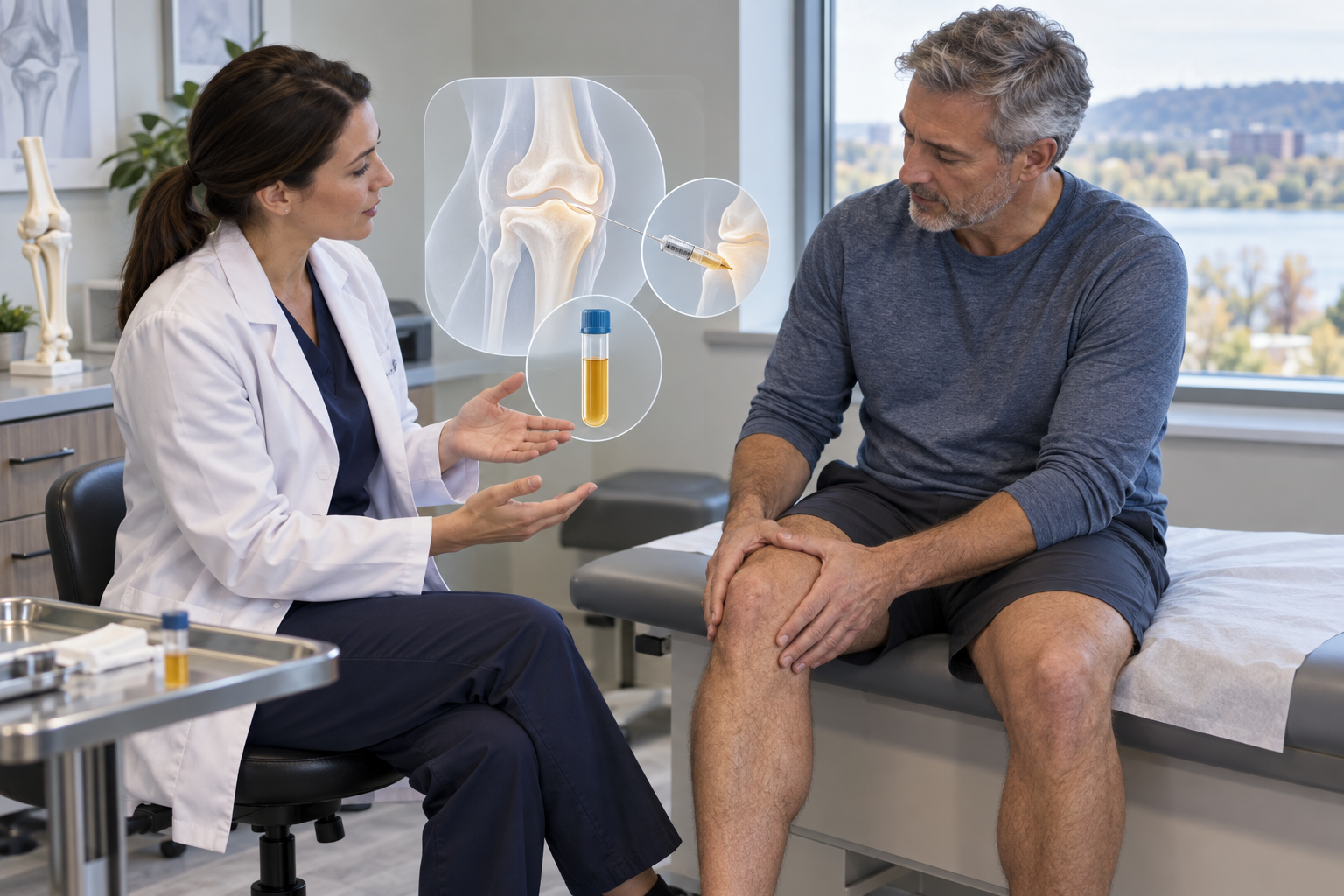
Prolotherapy is described in the medical literature as a nonsurgical regenerative injection technique that administers small amounts of an irritant solution to degenerated tendon insertions (entheses), joints, ligaments, and adjacent joint spaces over a series of several treatment sessions. The most studied form uses dextrose. The current theory is that the injected solution causes a healing process similar to the body's natural healing process, initiating a local inflammatory cascade that triggers the release of growth factors and collagen deposition. However, the mechanism of action is not completely understood.[PubMed Central]
Injection therapies such as prolotherapy are generally discussed when pain or functional limitations are significant despite oral medication or exercise. This is educational context only. It does not mean prolotherapy is right for any particular person, and it does not replace an evaluation by a qualified clinician.[PubMed Central]
What Does Current Research Say About Dextrose Prolotherapy?
These three injection approaches are not the same. Prolotherapy uses an irritant solution such as dextrose to provoke a healing-type response. PRP uses a prepared platelet concentrate. The cited review describes corticosteroid injections as the most common regimen for musculoskeletal disorders, providing short-term symptomatic improvement but potentially aggravating cartilage damage and increasing the risk of tissue atrophy. The meta-analysis found prolotherapy comparable to PRP and steroid injection on pain scores, and comparative conclusions remain limited by the need for larger, more homogeneous, longer-term trials. This article does not recommend one option over another for any reader.[PubMed Central]
How Do Prolotherapy, PRP, and Steroid Injections Differ?
These three injection approaches are not the same. Prolotherapy uses an irritant solution such as dextrose to provoke a healing-type response. PRP uses a prepared platelet concentrate. Corticosteroid injections are the most common regimen for musculoskeletal disorders; they provide short-term symptomatic improvement but may aggravate cartilage damage, increasing the risk of tissue atrophy. The meta-analysis found prolotherapy comparable to PRP and steroid injection on pain scores, and comparative conclusions remain limited by the need for larger, more homogeneous, longer-term trials. This article does not recommend one option over another for any reader.[PubMed Central]
If you want to compare these options for your own situation, a related patient guide on PRP injections in Syracuse, NY covers that topic in more detail: PRP Injections in Syracuse, NY: What Patients Should Understand Before Choosing a Non-Surgical Option.
| Approach | What is injected | What the cited review describes |
|---|---|---|
| Prolotherapy | An irritant solution, commonly dextrose | Non-surgical regenerative injection technique; pain scores comparable to PRP and steroid injection in the meta-analysis |
| PRP | A prepared platelet concentrate | Pain scores comparable to prolotherapy in the meta-analysis |
| Steroid injection | Corticosteroid | Short-term symptomatic improvement; may aggravate cartilage damage and increase tissue atrophy risk |
What Does a Prolotherapy Treatment Course Typically Involve?
Protocols are not standardized. Across the trials included in the cited review, dextrose concentrations ranged from 5% to 25%, and injection intervals ranged from weeks to months. Total sessions varied by study. For example, one protocol used three basic doses with additional injections allowed, while another used six treatments every two weeks. Injection sites also varied, including large joints such as the knee and small joints such as finger joints and carpometacarpal joints. These figures describe what was reported in research studies. They are not a recommended regimen, and any actual plan is determined by a treating clinician.[PubMed Central]
| Detail | Reported range |
|---|---|
| Dextrose concentration | 5% to 25% |
| Injection interval | Weeks to months |
| Total sessions | Varied by study (e.g., three basic doses with additional injections allowed; six treatments every two weeks in another) |
| Injection sites | Large joints such as the knee and small joints such as finger and carpometacarpal joints |
What Should You Ask Before Choosing Prolotherapy in Syracuse, NY?
These questions are meant to help you prepare for a consultation. They are not a substitute for individualized medical advice, and they do not determine whether prolotherapy is right for you.
Questions to bring to a consultation
- How will my symptoms be evaluated? Ask how the clinician assesses whether your symptoms fit a musculoskeletal pain pattern, and what examination or testing may be involved.
- What does the evidence show for my area of concern? Ask what the research suggests for the specific joint, tendon, or ligament involved, and what its limits are.
- What alternatives exist? Ask about other non-surgical and surgical options, including their potential benefits and risks.
- What does follow-up look like? Ask what a realistic follow-up and reassessment plan would involve, and how progress would be judged.
- What warning signs warrant urgent care? Ask what symptoms should prompt you to seek urgent medical attention rather than wait for a scheduled visit.
Important Limits of This Information
This article is general education. It cannot determine your diagnosis, candidacy for prolotherapy, individual treatment, or outcome. No guarantees of healing, tissue regeneration, pain relief, recovery speed, or return to activity are made here, and no superiority, success rate, or quantified outcome claims are made. The cited review describes prolotherapy as a cost-effective and safe treatment modality for chronic musculoskeletal pain within the context of the included trials, while also stating that more rigorous longer-term trials are needed. Individual risks, candidacy, and alternatives should be discussed with a qualified clinician. Exact contact details, provider credentials, and operational information must be verified from current official sources rather than assumed from this article.[PubMed Central]
Frequently Asked Questions
What is prolotherapy?
Prolotherapy is a non-surgical regenerative injection technique that delivers small amounts of an irritant solution, commonly dextrose, to degenerated tendon insertions, joints, ligaments, and adjacent joint spaces over a series of sessions. The leading theory is that it triggers a local healing-type inflammatory response, but the mechanism is not completely understood. This does not mean it is right for any particular reader.
Does research show prolotherapy works for chronic musculoskeletal pain?
A systematic review and meta-analysis of ten randomized controlled trials with 750 participants found that pain scores 6 months to 1 year after dextrose prolotherapy were significantly reduced compared with saline injection and exercise, and results were comparable to PRP or steroid injection. The authors stated that adequately powered, homogeneous, longer-term trials are still needed. This does not establish proven superiority or guaranteed relief.
How is prolotherapy different from PRP or steroid injections?
Prolotherapy uses an irritant solution such as dextrose, PRP uses a prepared platelet concentrate, and steroid injections are described in the cited review as offering short-term symptomatic improvement with potential cartilage and tissue concerns. The meta-analysis found comparable pain-score results between prolotherapy and both PRP and steroid injection, while comparative certainty remains limited. This article does not recommend one option.
How many prolotherapy sessions are typical, and how far apart?
Protocols varied across the included trials, with dextrose concentrations from 5% to 25% and injection intervals ranging from weeks to months, and total sessions differing by study. Protocols are not standardized, and any actual plan is determined by a treating clinician. No figure here is a recommended regimen.
Is prolotherapy safe?
The cited review describes prolotherapy as a cost-effective and safe treatment modality for chronic musculoskeletal pain within the context of the included trials, while also stating that more rigorous longer-term trials are needed. This is not a blanket safety claim. Discuss individual risks, candidacy, and alternatives with a qualified clinician.
Can this article tell me whether prolotherapy is right for me?
No. This is general education and cannot determine diagnosis, candidacy, individual treatment, or outcome. No guarantees of healing, pain relief, recovery speed, or return to activity are made. Consult a qualified clinician for personal medical decisions.