PRP for Knee Osteoarthritis: What the Evidence Shows About Pain Relief, Time Course, and Injection Schedules
PRP for Knee Osteoarthritis: The Short Answer
Platelet-rich plasma (PRP) is a preparation made from a person's own blood, processed to concentrate the platelet fraction, and then injected into the knee joint. It is offered as a non-surgical, injection-based option for people with symptomatic knee osteoarthritis. The most direct answer to whether it works is: the evidence is mixed and modest. A 2025 systematic review and meta-analysis of 11 randomized controlled trials with 1,616 participants comparing PRP with saline placebo found pooled pain results favoring PRP at three and six months, but the results were highly heterogeneous, and no efficacy was found at twelve months. Function favored PRP at three months but not at six or twelve months. The review's authors described the evidence as weak efficacy up to six months, with clinical relevance that remains debatable.[PubMed]
That is a different message from the one many patients encounter, where PRP is presented as a reliable way to avoid surgery or regrow cartilage. The supplied evidence does not support a cure, cartilage regrowth, or disease-reversal claim. What it supports is a narrower statement: PRP has been studied as a symptom-focused injection for knee osteoarthritis, with possible short-term pain benefit that is inconsistent across trials and not clearly sustained at one year. The sections below walk through the specific trials, the time points that were measured, the injection schedules that were studied, and the questions worth raising in a consultation. Nothing here is individualized medical advice, and candidacy for any injection requires clinical evaluation.[PubMed]
What PRP Is and Why It Gets Considered for Knee Osteoarthritis
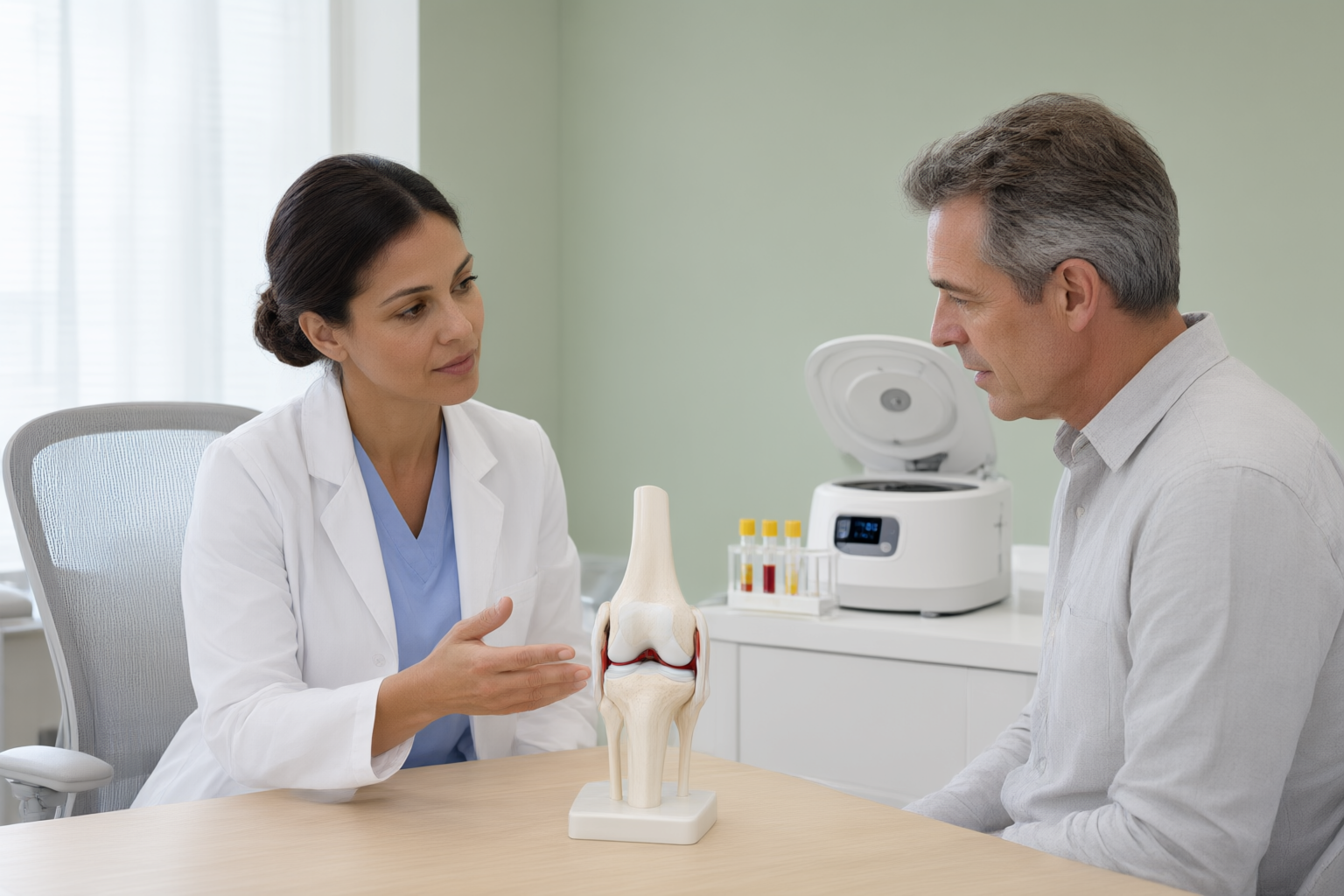
PRP is an autologous preparation, meaning it comes from the patient's own blood rather than a synthetic or donor product. Blood is drawn, processed to concentrate platelets, and the resulting preparation is injected into the knee joint. In the research literature, PRP is described as one of several autologous injectable options studied for knee osteoarthritis, alongside bone marrow aspirate concentrate. The rationale patients usually hear is straightforward: it is an injection rather than surgery, it uses the patient's own blood, and it is framed as a way to address symptoms without an operation.[PubMed]
That rationale explains why PRP is offered. It does not establish that PRP works, and it is worth separating the two ideas early. The evidence base for PRP varies by outcome, by time point, and by how the product was prepared, which is why a single confident statement about PRP in general is hard to support. A systematic review across musculoskeletal conditions found that results and protocols vary by condition, anatomical target, PRP preparation, comparator, and follow-up period. In practical terms, the question is not simply whether PRP works, but which preparation, for which joint, compared with what, and measured when.[PubMed]
What the Strongest Current Evidence Says
The clearest single source is the 2025 systematic review and meta-analysis of randomized controlled trials comparing intra-articular PRP with saline placebo for knee osteoarthritis. Across 11 trials and 1,616 participants, pooled pain scores favored PRP at three months and at six months, but with high heterogeneity, meaning the trials did not agree closely with one another. At twelve months, the review found no efficacy for pain. For function, pooled results favored PRP at three months but not at six or twelve months. The authors summarized this as weak efficacy up to six months and noted that the clinical relevance of the observed differences is debatable.[PubMed]
A separate randomized trial offers a different angle. In that study, 90 participants with symptomatic knee osteoarthritis (Kellgren-Lawrence grades 1 to 3) received a single intra-articular injection of either leukocyte-rich PRP or bone marrow aspirate concentrate. Both groups improved significantly from baseline by one month, and those improvements were sustained through twelve months, with no statistically significant difference between the two groups at any time point. The authors noted that PRP has stronger clinical evidence support than bone marrow aspirate concentrate, and also acknowledged a limitation: patients knew there was no control group, which may have influenced results.[PubMed]
Read together, these two sources point in the same cautious direction. PRP has some support for short-term symptom improvement in knee osteoarthritis, the size and consistency of that benefit is uncertain, and the evidence for benefit at one year is not established. Neither source supports describing PRP as a dependable long-term solution or as a structural treatment for the disease.[PubMed][PubMed]
PRP Evidence at a Glance: Outcomes, Time Points, and Strength of Support
The table below consolidates the pooled findings from the 2025 review so the time course is easy to compare. All entries apply to the review's knee osteoarthritis population and its saline-placebo comparison.[PubMed]
| Outcome | Time point | Direction of pooled effect | Strength or limitation |
|---|---|---|---|
| Pain | 3 months | Favors PRP | Highly heterogeneous across trials |
| Pain | 6 months | Favors PRP | Highly heterogeneous; authors describe weak efficacy |
| Pain | 12 months | Does not favor PRP | No efficacy found in this review |
| Function | 3 months | Favors PRP | Weak, debatable clinical relevance |
| Function | 6 months | Does not favor PRP | No pooled benefit reported |
| Function | 12 months | Does not favor PRP | No pooled benefit reported |
How Long Relief Might Last, and What to Realistically Expect
The studied time window for possible benefit is roughly three to six months. In the 2025 review, pooled pain benefit appeared at three and six months and was not found at twelve months. That does not mean every patient's relief stops at six months, and it does not mean relief is guaranteed within that window either. It means that when trials were pooled, the measurable advantage over placebo was concentrated in the earlier follow-up points and was not detectable at one year.[PubMed]
The comparison trial adds context rather than reassurance. In that study, both PRP and bone marrow aspirate concentrate groups showed sustained improvement through twelve months, but there was no placebo arm, so the improvement cannot be attributed to the injection alone. Patients in an open-label trial may report improvement for reasons unrelated to the product. The honest practical takeaway is that a few months of possible benefit is a reasonable expectation to discuss, that longer-term benefit is uncertain, and that no individual response date can be promised.[PubMed]
Single Injection or a Series? What the Studied Schedules Look Like
Injection schedules in the literature are not uniform. A systematic review and meta-analysis specifically compared single versus multiple PRP injections for knee osteoarthritis. Reviewed trials included protocols using three injections separated by about one week, and outcomes were assessed over follow-up periods that included 3, 6, and 9 months. The review did not establish a universal injection count, and its findings apply to knee osteoarthritis study populations rather than to every joint, tendon, or preparation.[PubMed]
The comparison trial described earlier used a single injection of leukocyte-rich PRP and still reported improvement through twelve months, which shows that a single-injection protocol has also been studied. What the literature does not provide is a clear answer to whether more injections reliably produce better results. If you are comparing protocols, the useful question is not which schedule is standard, because no single standard is established, but which schedule the specific evidence for that preparation supports and how benefit will be judged afterward.[PubMed][PubMed]
PRP Compared With Other Injection Options: What the Trials Actually Tested
The most direct head-to-head comparison in the supplied evidence is PRP versus bone marrow aspirate concentrate. In the 90-participant randomized trial, both treatments improved WOMAC and IKDC scores from one month through twelve months, and there was no statistically significant difference between groups at any time point. The authors concluded that neither treatment provided superior clinical benefit in mild to moderate knee osteoarthritis, while noting that PRP has stronger clinical evidence support than bone marrow aspirate concentrate.[PubMed]
A separate placebo-controlled trial of bone marrow aspirate concentrate is worth knowing about because it complicates the picture. In that study, 25 patients with bilateral knee osteoarthritis received bone marrow aspirate concentrate in one knee and saline in the other. Pain scores in both knees decreased significantly from baseline at one week, three months, and six months, and the difference between the treated and saline knees was not statistically significant. The authors concluded that further study was needed to determine mechanisms, duration of efficacy, and optimal treatment frequency.[PubMed]
That result is a useful reminder about injection trials generally: improvement after an injection is not automatically evidence that the injected substance caused the improvement. The comparison between PRP and other injectable options is also narrower than it may appear. The supplied evidence covers PRP versus bone marrow aspirate concentrate and PRP versus saline, not PRP versus every other injection a clinician might offer. For a broader comparison of these two regenerative options, see our PRP vs BMAC comparison.[PubMed][PubMed]
Why Knee Osteoarthritis Evidence Does Not Transfer to Other Conditions
It is natural to wonder whether results for the knee apply to a painful shoulder, elbow, or Achilles tendon. The evidence says not to assume that. A systematic review across musculoskeletal injuries found that results and protocols vary by condition, anatomical target, PRP preparation, comparator, and follow-up period. Those variables are not incidental details; they change what a study is actually measuring. A preparation and schedule studied in knee osteoarthritis may not be the same one studied in a tendon, and the healing environment differs by tissue.[PubMed]
The practical implication is that PRP evidence should be discussed condition by condition. Knee osteoarthritis findings should not be applied to other joints, tendons, or ligaments, and no universal timeline or injection series is established across musculoskeletal problems. If you are researching PRP for a different area, look for evidence specific to that condition rather than extrapolating from knee arthritis trials.[PubMed][PubMed]
Questions Worth Bringing to a Consultation
The evidence review is most useful when it becomes a set of specific questions. These are discussion prompts, not individualized advice, and they are not a checklist that determines whether PRP is appropriate for you. Candidacy and treatment decisions require clinical evaluation of your knee, your symptoms, and your history.[PubMed]
Questions to ask before deciding on PRP
- Which preparation and protocol would be used? Ask what specific PRP preparation is planned and what published evidence exists for that preparation in knee osteoarthritis.
- How many injections, and over what interval? Ask whether a single injection or a series is planned, and note that reviewed trials have used protocols such as three injections about one week apart without establishing a universal count.
- How will benefit be judged, and when? Ask what follow-up window would be used to decide whether the treatment helped, given that pooled benefit in the 2025 review appeared at three and six months and not at twelve.
- How was the uncertainty weighed? Ask how the weak and heterogeneous evidence up to six months, and the absence of demonstrated twelve-month benefit, factored into the recommendation.
- What alternatives were considered? Ask what non-injection options and other approaches were weighed, and why PRP is being suggested specifically.
- What are the cost and coverage details? Ask the practice directly about costs, billing, and insurance coverage, and confirm any coverage questions with your insurer.
Frequently Asked Questions
Does PRP cure or reverse knee osteoarthritis?
No supplied evidence supports a claim that PRP cures knee osteoarthritis, regrows cartilage, or reverses the disease. The 2025 meta-analysis reported weak, heterogeneous symptom benefit up to six months and no demonstrated efficacy at twelve months. PRP is best described as a studied symptom-focused injection option, not a structural treatment.
How soon after a PRP injection might I notice a difference?
In the 2025 review, pooled pain benefit appeared at three and six months. In a separate randomized trial, both treatment groups improved significantly by one month and sustained that improvement through twelve months, though that trial had no placebo arm. Group averages do not predict an individual timeline, and no response date can be promised.
How many PRP injections will I need for knee osteoarthritis?
Reviewed trials have included protocols such as three injections about one week apart, and a systematic review compared single versus multiple injections without establishing a universal count. A single-injection protocol has also been studied. The appropriate schedule for any individual is a clinical decision, not something an article can determine.
Is PRP safer than other knee osteoarthritis treatments?
The supplied evidence focuses on efficacy outcomes rather than comparative safety, so a comparative safety claim is not supported here. The 2025 review characterized PRP efficacy as weak and of debatable clinical relevance. Risks, alternatives, and your own situation should be discussed with a clinician rather than decided from this article.
Will insurance cover PRP for knee osteoarthritis?
Coverage and payment details are not established by the supplied evidence. They must be confirmed directly with the practice and with your insurer. This article does not promise coverage, reimbursement, or any price.
Can I apply these PRP results to my shoulder, elbow, or Achilles problem?
A systematic review across musculoskeletal injuries found that results and protocols vary by condition, anatomical target, PRP preparation, comparator, and follow-up period. Knee osteoarthritis findings should not be generalized to other sites. Discuss PRP for another area with a clinician using evidence specific to that condition.
References
- A Prospective, Single-Blind, Placebo-Controlled Trial of Bone Marrow Aspirate Concentrate for Knee Osteoarthritis. — pubmed.ncbi.nlm.nih.gov
- Bone Marrow Aspirate Concentrate Is Equivalent to Platelet-Rich Plasma for the Treatment of Knee Osteoarthritis at 1 Year: A Prospective, Randomized Trial. — pubmed.ncbi.nlm.nih.gov
- Single versus multiple PRP injections for knee osteoarthritis (systematic review and meta-analysis) — pubmed.ncbi.nlm.nih.gov
- PRP for musculoskeletal injuries (systematic review) — pubmed.ncbi.nlm.nih.gov
- PRP versus placebo for knee osteoarthritis: 2025 systematic review and meta-analysis — pubmed.ncbi.nlm.nih.gov