PRP for Hair Loss in Syracuse: What the Evidence Shows and What to Ask Before Treatment
Does PRP Actually Help Hair Loss? A Direct Answer
For people considering PRP for hair loss in Syracuse, the most useful starting point is what the research actually measured. A 2025 systematic review and meta-analysis pooled 43 randomized controlled trials involving 1,877 participants and concluded there is moderate evidence that platelet-rich plasma (PRP) is safe and effective for improving hair density, reducing hair loss, and enhancing clinical outcomes and patient satisfaction. In the same analysis, activated PRP was effective in increasing hair density and minimizing recurrence compared with placebo, while non-activated PRP was associated with a higher frequency of adverse effects.[PubMed]
The same review drew a clear line around what PRP did not appear to improve: no significant benefits were demonstrated for hair thickness or other follicle-related parameters. The authors also noted that study heterogeneity and incomplete reporting of how PRP composition affected results limited firm conclusions, and that further high-quality, standardized trials are needed. In practical terms, that means the evidence supports a modest, specific set of outcomes rather than a promise of regrowth, and it does not predict how any one person will respond.[PubMed]
What the Evidence Supports and What It Does Not
The clearest way to read the alopecia evidence is to separate outcomes the pooled trials supported from those they did not. The table below summarizes that split, based on the 2025 review of 43 randomized trials.[PubMed]
| Outcome | What the evidence showed |
|---|---|
| Hair density | Increased with PRP, particularly activated PRP versus placebo |
| Hair loss | Decreased with PRP therapy regardless of activation status or control type |
| Clinical improvement and patient satisfaction | Improved; satisfaction was generally favorable |
| Recurrence | Minimized with activated PRP compared with placebo |
| Hair thickness | No significant benefit demonstrated |
| Other follicle-related parameters | No significant benefit demonstrated |
| Effect by alopecia subtype | No significant variation in overall effect attributable to alopecia subtype |
Why PRP Preparation Details May Matter
One of the more practical findings in the 2025 review concerns how PRP is prepared. Activated PRP was associated with increased hair density and fewer recurrences compared with placebo, whereas non-activated PRP was linked to a higher frequency of adverse effects. The authors concluded that activation status appears to influence response, which highlights the importance of preparation protocols.[PubMed]
That finding is a reason to ask how a product is made, not a reason to assume one approach is superior. The same review cautioned that heterogeneity in study designs and incomplete reporting of PRP composition-related factors limited the ability to draw firm conclusions about which formulation works best. This article does not recommend a specific protocol; the useful takeaway is that preparation is a legitimate question for a clinician.[PubMed]
What a PRP Consultation Typically Involves and What It Cannot Promise
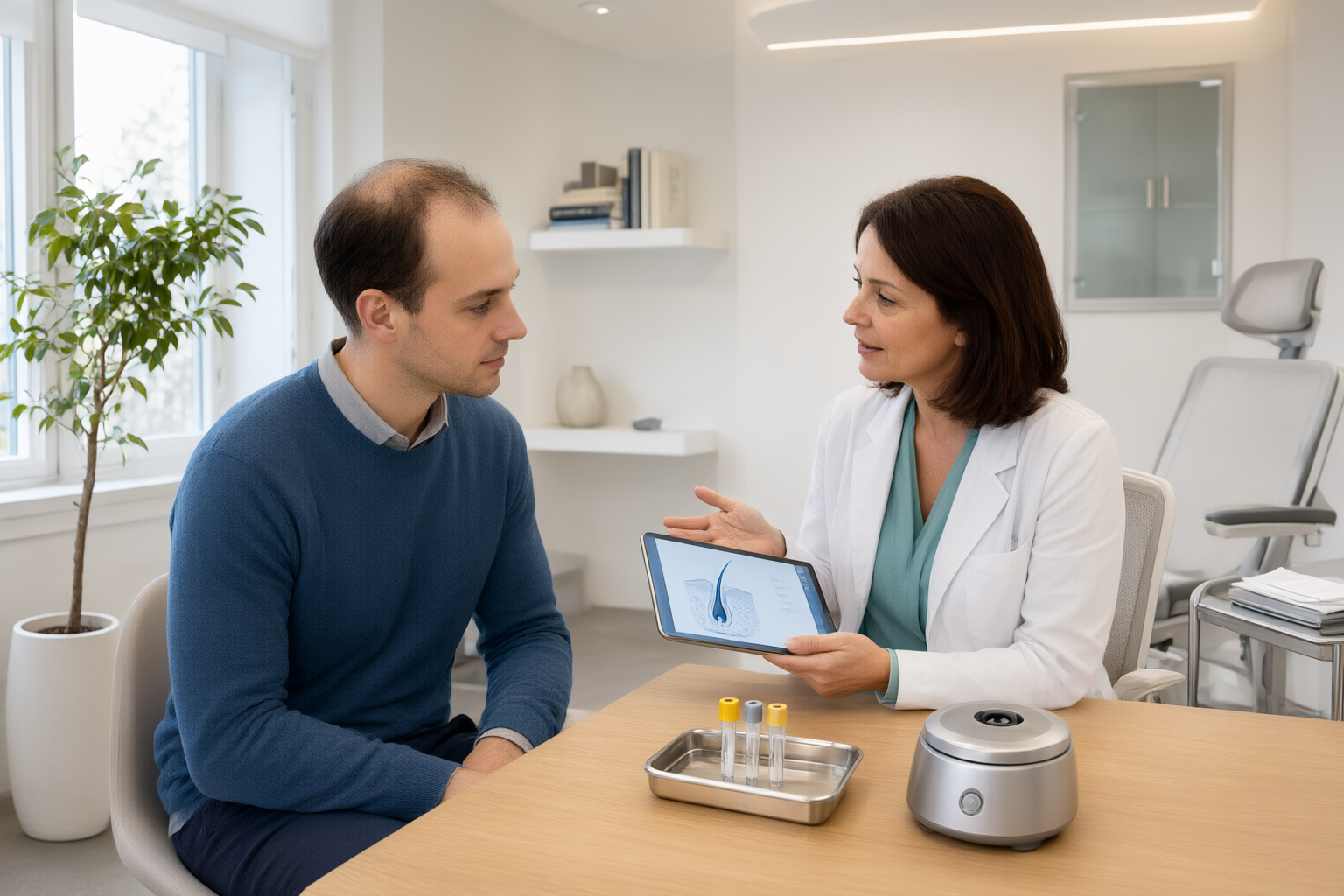
A consultation is a conversation, not a verdict. It generally covers the person's pattern of hair loss, relevant history, and goals, and a review of whether PRP is a reasonable option among several. The 2025 review describes PRP as a minimally invasive autologous therapy whose effectiveness remains debated, which is a fair summary to bring into that discussion.[PubMed]
What a consultation cannot do is guarantee an outcome. PRP is not a diagnosis, not a promise of regrowth, and not personalized treatment advice from this article. This article cannot determine whether someone is a candidate or predict individual results. For general background on how PRP is used in non-surgical care, see our guide to PRP injections in Syracuse, NY.[PubMed]
Questions to Ask Before Choosing PRP in Syracuse
The evidence is most useful when it becomes a set of questions for your own clinician. The list below is framed as questions to ask, not answers this article can supply.[PubMed]
Practical questions for a local consultation
- What evidence are you relying on? Ask which studies or reviews inform the clinician's view of PRP for alopecia, and how they weigh the moderate quality of the pooled evidence.
- How is the PRP prepared? Ask whether the preparation is activated or non-activated, since activation status appeared to influence response and side effects in the reviewed trials.
- How many sessions, over what timeframe? Ask how many sessions are typically discussed and over what period, and how progress will be assessed.
- What side effects have been reported? Ask what adverse effects have been observed and which personal risk factors matter for you.
- What are the alternatives? Ask how PRP compares with other options for your pattern of hair loss, and what happens if you choose not to treat.
How PRP for Hair Compares With PRP for Joint and Tendon Conditions
PRP evidence is condition-specific and should not be transferred from one use to another. For context, a 2024 meta-analysis of intra-articular PRP versus saline in knee osteoarthritis found weak efficacy up to about 6 months, with no efficacy shown at 12 months, and the authors described the clinical relevance of PRP use as debatable.[PubMed]
A separate systematic review of PRP for musculoskeletal soft-tissue injuries concluded that there is currently no research strongly advocating PRP over traditional management strategies such as rest, ice, corticosteroid injection, and rehabilitation. Neither finding says anything about hair loss outcomes, and neither should be read as a ranking of one use over another. They simply illustrate why alopecia evidence has to be read on its own terms.[PubMed]
If cost or coverage is part of your decision, our overview of PRP cost and insurance coverage explains what to clarify with a practice. Readers comparing non-surgical options more broadly may also find our guide to prolotherapy in Syracuse, NY useful background.
Frequently Asked Questions
Does PRP regrow hair?
The evidence is more specific than "regrowth." A 2025 meta-analysis of 43 randomized trials found moderate evidence that PRP increased hair density and reduced hair loss, but it did not significantly improve hair thickness or other follicle-related measures. Study heterogeneity was substantial, so individual results vary and are not guaranteed.
Is PRP for hair loss safe?
The 2025 review described PRP as a minimally invasive autologous therapy and characterized it as relatively safe, with generally favorable satisfaction. However, non-activated PRP was associated with a higher frequency of adverse effects than activated PRP. No treatment is universally risk-free, so discuss your personal risk factors with a clinician.
How many PRP sessions are needed for hair loss?
The supplied evidence does not establish a standard number of sessions for alopecia, and protocols varied across the 43 trials reviewed. Ask your clinician how many sessions are typically discussed, over what timeframe, and how results will be assessed.
Is PRP for hair loss covered by insurance or how much does it cost in Syracuse?
This article does not provide pricing or insurance information and cannot promise coverage. Ask the practice directly about cost and coverage, and see our related article on PRP cost and insurance coverage for general guidance.
How is PRP for hair loss different from PRP for knee arthritis?
The evidence is condition-specific. Hair-loss conclusions come from alopecia trials, while a 2024 knee osteoarthritis meta-analysis found weak short-term efficacy and no efficacy at 12 months. Results should not be transferred between conditions, and neither use should be described as superior based on these sources.
Can this article tell me whether PRP is right for me?
No. This is general education and cannot determine a diagnosis, candidacy, or individual treatment. Discuss your hair loss pattern, history, and goals with a qualified clinician.
References
- Update on the Use of Platelet-Rich Plasma Injections in the Management of Musculoskeletal Injuries: A Systematic Review of Studies From 2014 to 2021. — pubmed.ncbi.nlm.nih.gov
- Efficacy of intra-articular platelet-rich plasma compared with placebo in knee osteoarthritis: A systematic review and meta-analysis. — pubmed.ncbi.nlm.nih.gov
- Platelet-Rich Plasma in the Management of Alopecia: A Systematic Review and Meta-Analysis of Clinical Evidence. — pubmed.ncbi.nlm.nih.gov